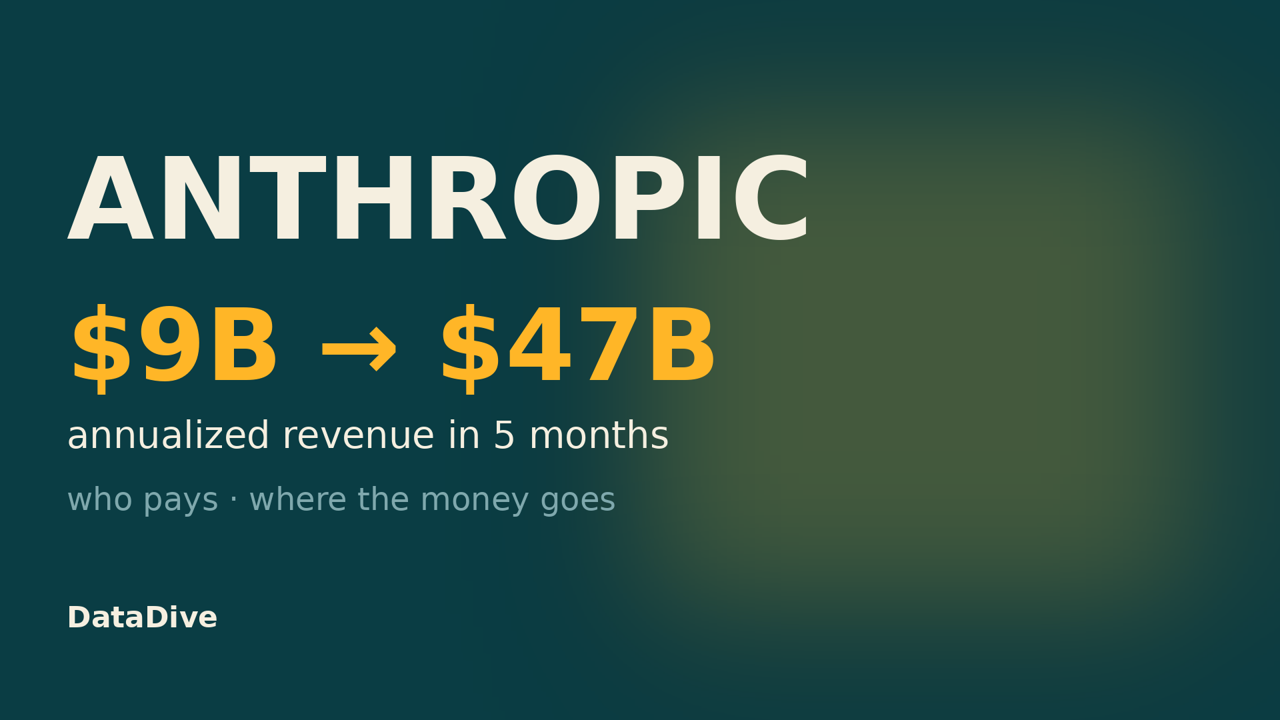
At the end of 2025, Anthropic's annualized revenue was about $9 billion. In May 2026 the company said it had crossed $47 billion, and its valuation rose from $380 billion to $965 billion in the same stretch. This article follows the money: how fast it grew, who pays, where the money goes, and what the company has not yet published.
A note on the numbers. "Run-rate" is the revenue of a recent period multiplied up to a full year. It is stated by the company and is not audited revenue. Anthropic is private, so most figures come from its own announcements or press reports, and each is labelled below. Full disclosure: this text was drafted with the help of an AI assistant made by Anthropic; every claim is tied to a public source.
From a lab to a company
Anthropic was founded in January 2021 by former OpenAI researchers, among them siblings Dario Amodei (CEO) and Daniela Amodei (President). It is a Delaware public benefit corporation, a legal form that lets the board weigh a stated public purpose next to profit. The first Claude model reached the public in early 2023 and the Claude 3 family followed in 2024. By February 2026, Anthropic said its coding tool, Claude Code, alone had a run-rate above $2.5 billion.
How fast it grew
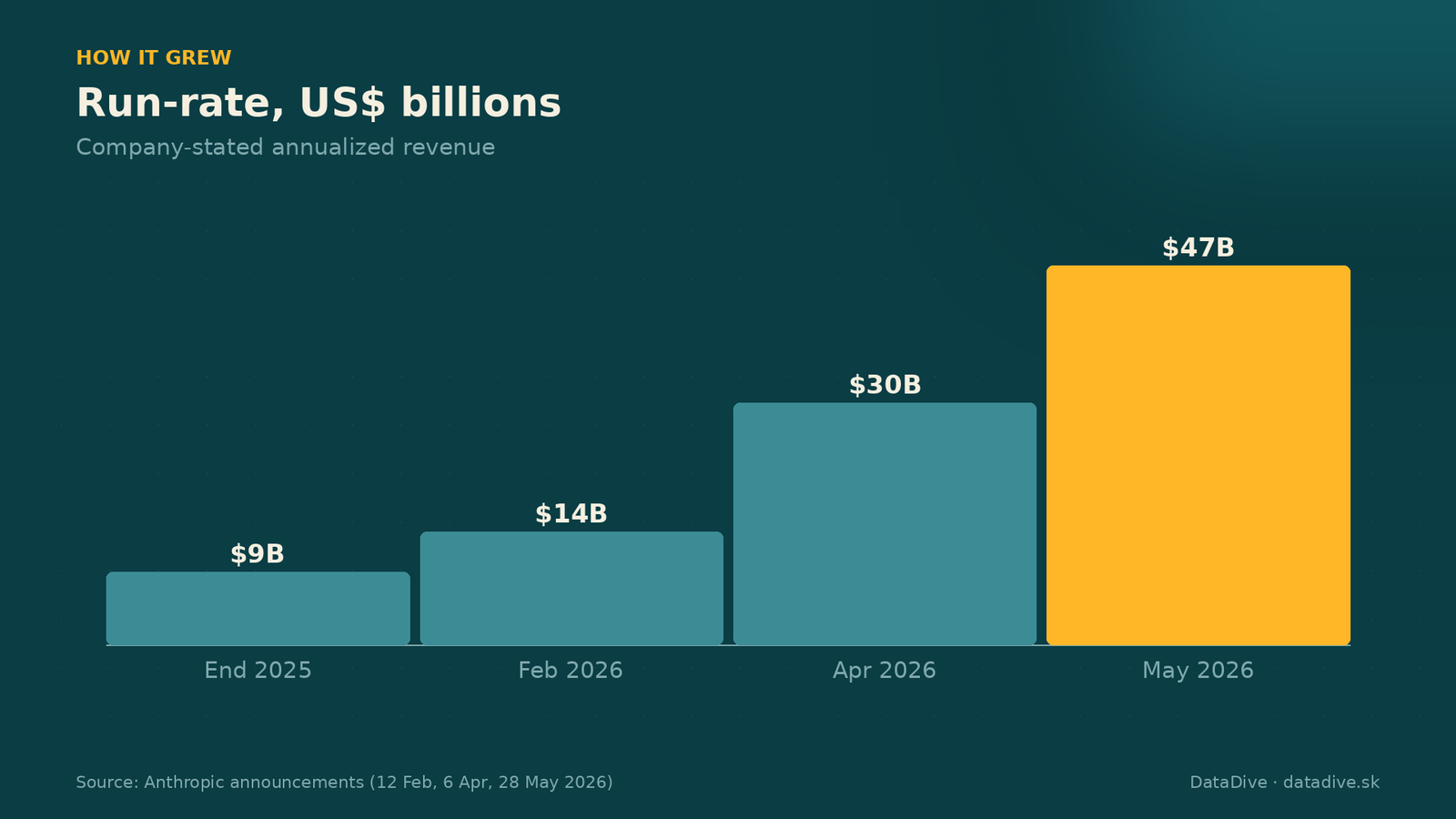
- 12 February 2026: run-rate of $14 billion, which Anthropic said had grown more than tenfold in each of the previous three years.
- 6 April 2026: run-rate above $30 billion, up from about $9 billion at the end of 2025.
- May 2026: run-rate above $47 billion, as stated by Anthropic and reported by TechCrunch.
That is roughly five times higher in about five months.
Who pays
Mostly businesses. In February, Anthropic said customers spending more than $1 million a year had grown from a dozen two years earlier to more than 500; by April the number was above 1,000. Customers spending more than $100,000 a year grew 7 times in a year, and eight of the Fortune 10 were customers. Anthropic also cited a SemiAnalysis estimate that Claude Code accounted for about 4% of all public GitHub commits, double the share a month earlier. The company has not published a split of revenue by product.
The money in
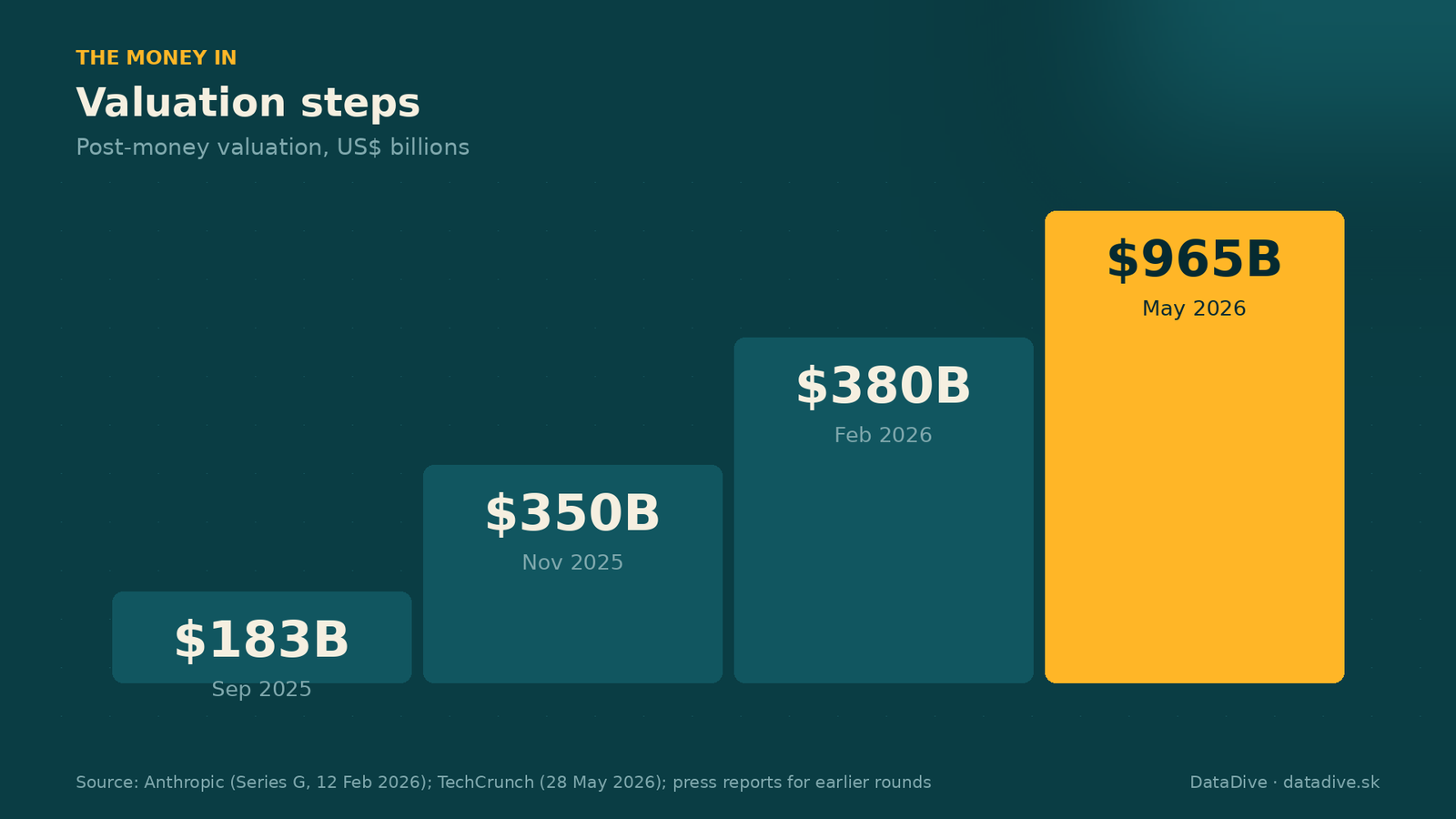
- September 2025: a round reported at $183 billion.
- November 2025: about $350 billion, reported when Microsoft and Nvidia agreed to invest.
- 12 February 2026: $30 billion raised at $380 billion post-money (Series G, led by GIC and Coatue).
- 28 May 2026: $65 billion raised at $965 billion (Series H, co-led by Altimeter, Dragoneer, Greenoaks, Sequoia and others). About $15 billion of it was money that cloud partners had already committed, including $5 billion from Amazon announced in April. Samsung, SK Hynix and Micron joined as strategic partners.
Our calculation of valuation divided by run-rate gives about 27 times in February ($380B ÷ $14B) and about 21 times in May ($965B ÷ $47B): revenue grew faster than the valuation. For comparison, TechCrunch reported that OpenAI raised $122 billion in March at an $852 billion valuation.
The money out: compute
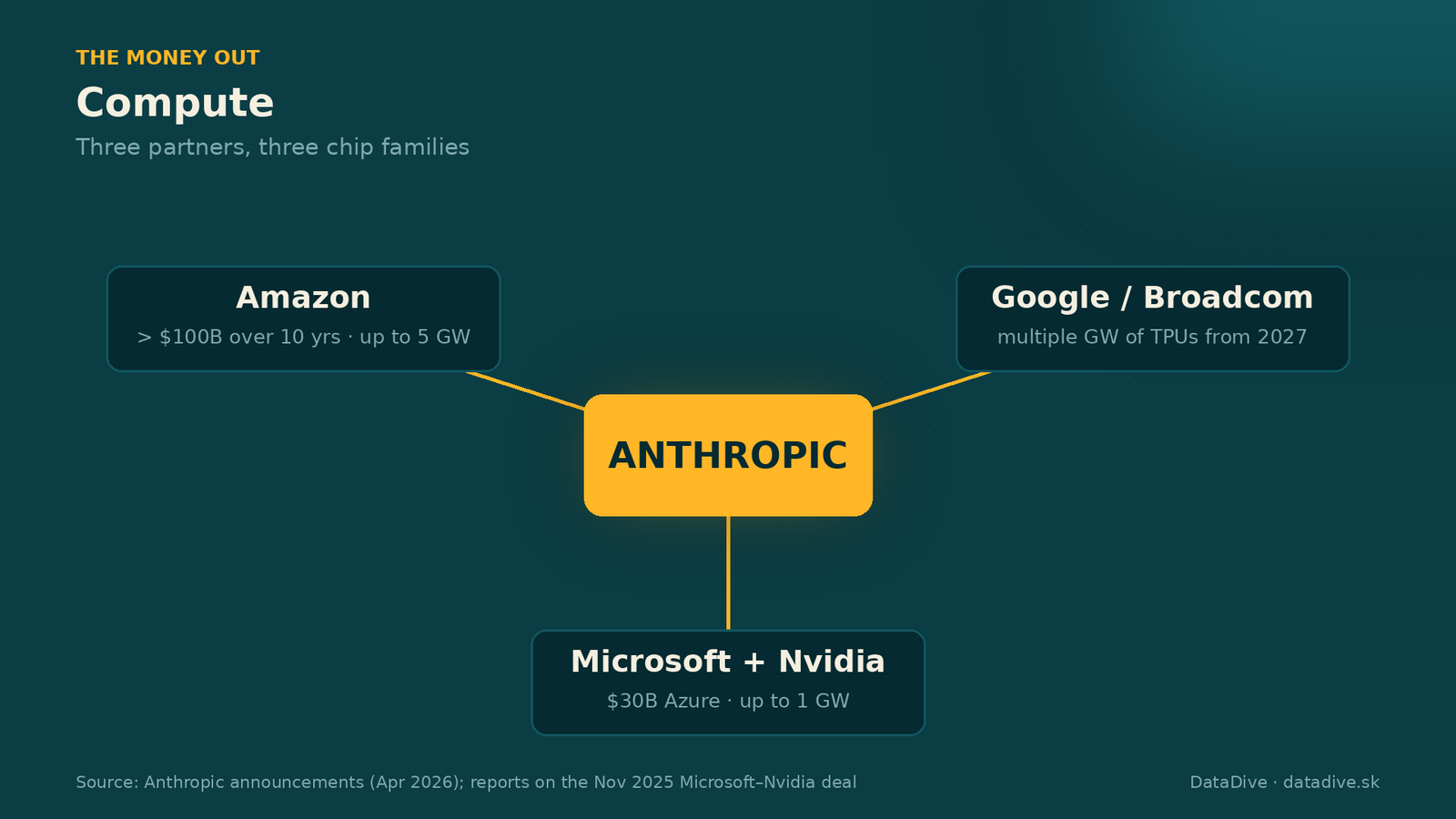
- Amazon is the primary cloud and training partner. In April, Anthropic committed more than $100 billion over ten years to Amazon technology, for up to 5 gigawatts of capacity. It uses more than one million Trainium2 chips, and nearly 1 gigawatt of Trainium capacity is due by the end of 2026. Amazon invested $5 billion in April, with up to $20 billion more, after $8 billion earlier.
- Google and Broadcom will supply multiple gigawatts of next-generation Google TPU capacity, starting in 2027.
- Microsoft and Nvidia: Anthropic committed $30 billion to Azure and up to 1 gigawatt of Nvidia systems; Microsoft and Nvidia were reported to invest up to $5 billion and $10 billion.
The same companies appear on both sides: they invest in Anthropic and sell it computing power. Critics call this circular financing. That describes the structure, not an accusation, but it means part of the demand for chips depends on the funding continuing. (Nvidia's chief executive has said 10 gigawatts of data centers means 4 to 5 million of its GPUs; Anthropic mostly uses Amazon's and Google's own chips, so that ratio does not apply to it directly.)

For scale only: Amazon (more than $100 billion) plus Azure ($30 billion) is more than $130 billion, about 2.8 times the May run-rate of $47 billion. The commitments run over many years, so the comparison is rough, but it shows why the company keeps raising money: the compute bill comes first and revenue has to follow.
The open question: profit
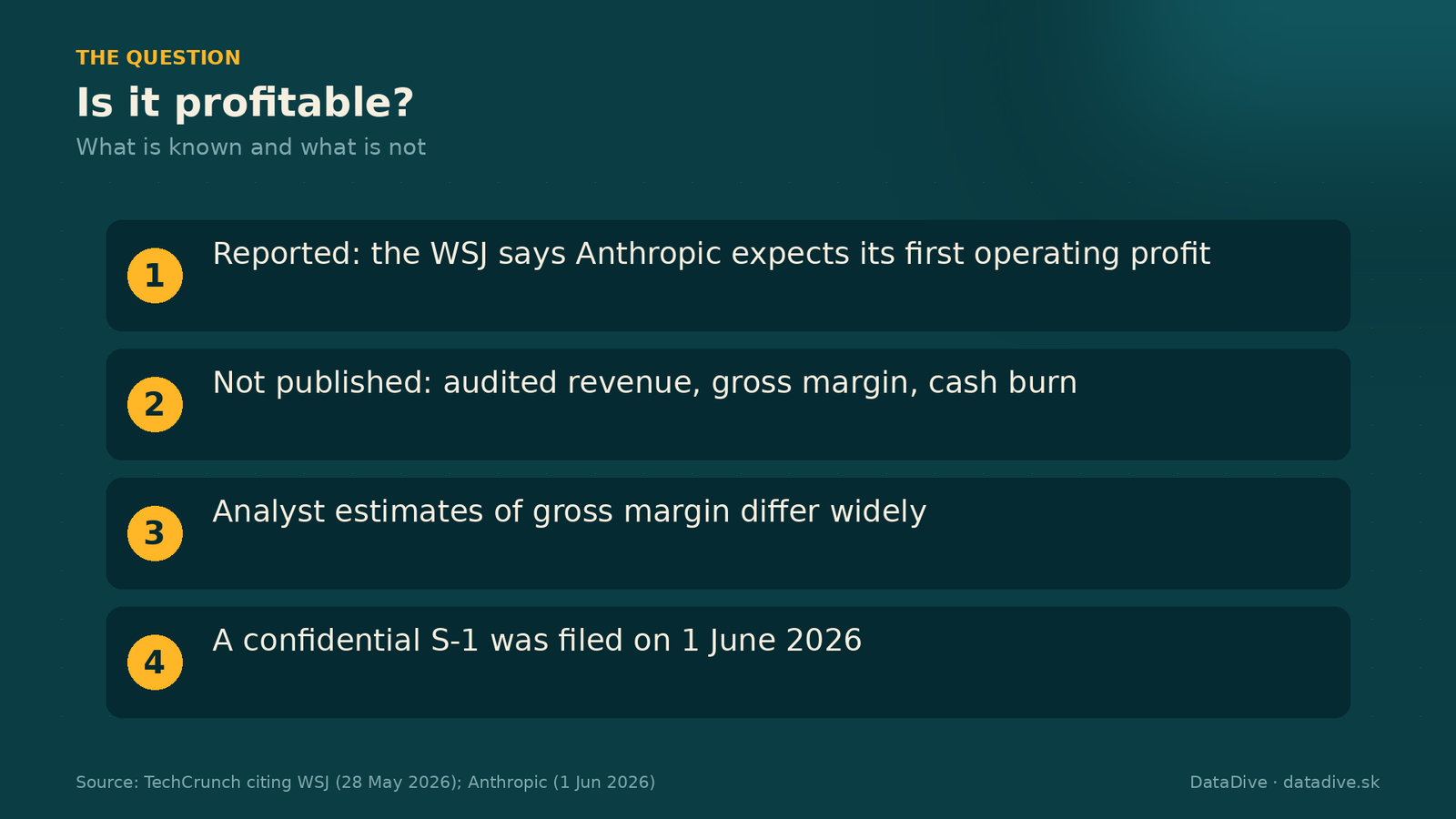
The Wall Street Journal, as cited by TechCrunch, reported that Anthropic expects its first operating profit. That is a report, not a company statement. Anthropic has not published audited revenue, gross margin or cash burn, and analyst estimates of the margin differ widely. On 1 June 2026 it confidentially submitted a draft registration statement (Form S-1) to the SEC, the first formal step toward a listing. The public version should show audited numbers for the first time.
What could go wrong
- Compute commitments are fixed years ahead; revenue growth is not.
- A few large partners are investor, supplier and sales channel at the same time.
- Prices of AI models can fall as competitors catch up.
- A run-rate can fall back; it is not audited.
None of this says it will happen. These are the places where the numbers could turn.
What to watch
The audited figures in the public S-1; revenue growth against the compute bill; capacity coming online (nearly 1 gigawatt of Trainium by the end of 2026, TPUs from 2027); and how the valuation compares with OpenAI's at a listing. This is analysis of public information, not investment advice.
Sources
- Anthropic, Series G announcement (12 February 2026)
- Anthropic, Google and Broadcom compute (6 April 2026) and Amazon compute (20 April 2026)
- TechCrunch, Anthropic raises $65 billion (28 May 2026)
- Anthropic, confidential draft S-1 (1 June 2026)
- Capital Brief, Microsoft and Nvidia invest in Anthropic (November 2025)
- Anthropic (Wikipedia), company history